
Bona Traffic GO
A new tide for high traffic floors

Bona Traffic GO
A new tide for high traffic floors
Advanced technology for simplicity & efficiency
Discover the secrets behind the unique 2K technology. It enables tough, professional durability while being simple to use. Bona develops its own polymers as the foundation for this achievement. This has given Bona the possibility to adapt the building blocks in the lacquer, making them form a highly durable, yet flexible protective layer without adding isocyanates. The result is a new and unique 2K technology where the hardener is included in the lacquer – a built-in hardener.

Built-in hardener creates a simpler curing process
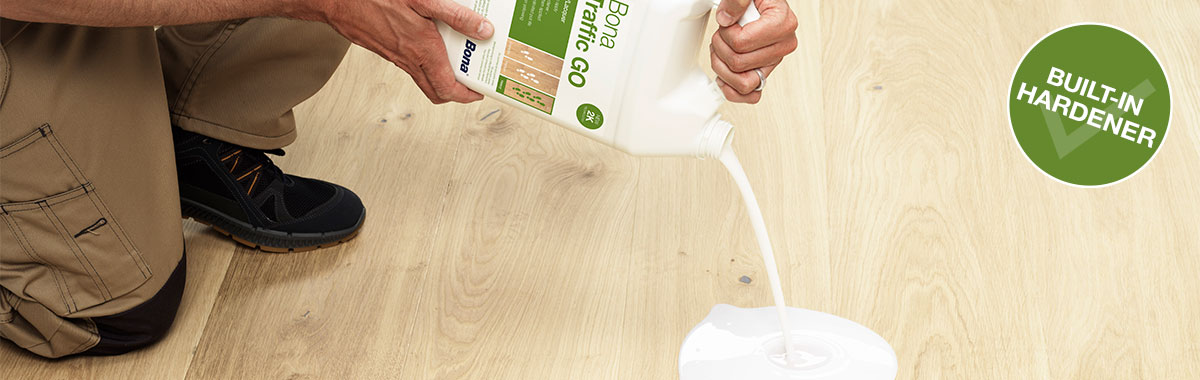
The built-in hardener found in Bona Traffic GO is a unique self-activated hardener, activated once the product is applied to the wood surface. This all-new 2K technology makes the Bona Traffic GO perform as a 2K product designed for heavy wear areas, with all the benefits of a 1K lacquer.

Polymers with built-in hardener
Curing starts as soon as the lacquer is applied on the floor.

Activates when applied on floor
The water leaves the product and creates a web connecting all polyurethane (PU) particles into one large net, creating a more stable system with high resistance against stains, scuffing, and wear.

Hardens into a durable surface
The drying process generates the high durability of the web through a chemical reaction between the molecules in the lacquers and the built-in hardener. This creates the foundation for better lacquer performance, yet with a safe and simple process.
How Bona's built-in hardener creates a simpler curing process
Bona's unique built-in hardener is activated once the product is applied to the wood surface. The drying process generates the high durability of the web through a chemical reaction between the molecules in the lacquers and the built-in hardener. This creates the foundation for better lacquer performance, yet with a safe and simple process. This all-new 2K technology makes Bona Traffic GO perform as a 2K product designed for heavy wear areas, with all the benefits of a 1K lacquer.
The drying process of 1K and 2K lacquers
The drying process for all lacquers follows the same principles. A lacquer consists of about 30-40 % dispersion, i.e., very small plastic particles or polymers (about 0.0001 mm) in a carrier fluid.

Polymers in carrier fluid
For waterborne finishes, this fluid is water.

Carrier fluid evaporates
When the fluid evaporates, the polymers form a coat that protects the floor.

Polymers melts into a coat
After some time, the polymers will dissolve and melt together, forming a
thin, smooth film on the wood, hardening the surface.

Surface hardens over time
This allows the properties of the lacquer to improve and create a durable, protective coat. A freshly coated wood floor must therefore be treated carefully before it is fully dried.
Hardening with traditional 2K formula
To enhance the durability of the lacquer, a 2K formula can be used. A 2K lacquer is very resistant against stains, as well as scuffs and scratches, because of the extra-firm coat, making it very suitable for high traffic areas. However, once mixed it has a very limited pot life and the tools are difficult to clean.

Free polymers in carrier fluid
For waterborne finishes, this fluid is water.

Hardener added
Unlike the built-in hardener in Bona Traffic GO, an additional hardener must be added just before application.

Hardening process activated
All two-component products then dry through a chemical reaction, not just through the evaporation of the fluid.

Bonding into a durable surface
The chemical reaction of the hardener will create a web that bonds the free polymers to each other, thus creating a more stable system than if they were not linked together.