Test results - coarse and medium sanding
With over 100 years of experience in wooden floors, Bona features a unique range of abrasives. Their development is based on the special requirements of all sanding sequences, delivering unrivalled results.


Test results - coarse and medium sanding
With over 100 years of experience in wooden floors, Bona features a unique range of abrasives. Their development is based on the special requirements of all sanding sequences, delivering unrivalled results.
An extensive test was performed in Stuttgart, Germany, comparing the most commonly-used competitor abrasives to the Bona Abrasives Range. 800 m2 of oak parquet, previously coated with a two-component finish, was used for the test. The attributes measured were durability, speed, fibre-ripping and removal rate.
Removal efficiency
"41% better removal efficiency"
The different abrasives were put to the test in the removal of an old two-component finish and its line marking, which was the original coating on the sports floor.
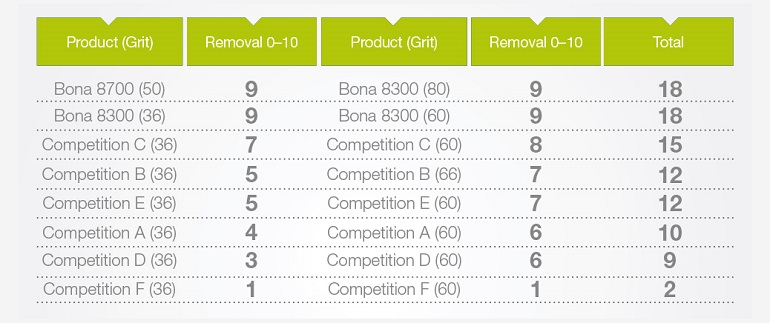
The sanding process consisted of coarse sanding with lower grit papers, followed by medium sanding with finer grit papers. For coarse & medium sanding, Bona 8700 (grit 50) + Bona 8300 (grit 80) showed an equally excellent removal efficiency as Bona 8300 (grit 36) + Bona 8300 (grit 60). Closest competitor C (grit 36) + (grit 60) had good initial efficiency, but its high removal rate gradually deteriorated.
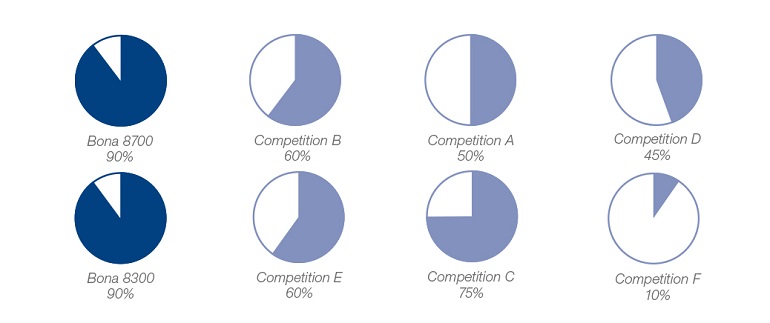
For coarse sanding alone, the most efficient removal rates were obtained with Bona 8700 (grit 50) and Bona 8300 (grit 36), with both at 90%. The closest competitor had a removal efficiency of 75%.
Speed
"22% faster than average"
Each brand was allocated a 75 m2 piece of parquet that was previously coated with a 2-component finish. Results were measured after both initial coarse sanding, as well as after the sequence of coarse & medium sanding.
Coarse sanding was regarded as completed when the old finish had been properly removed. When scratches from coarse sanding had been removed, medium sanding was regarded as completed. Time and number of belts used were measured and reviewed as the test results.
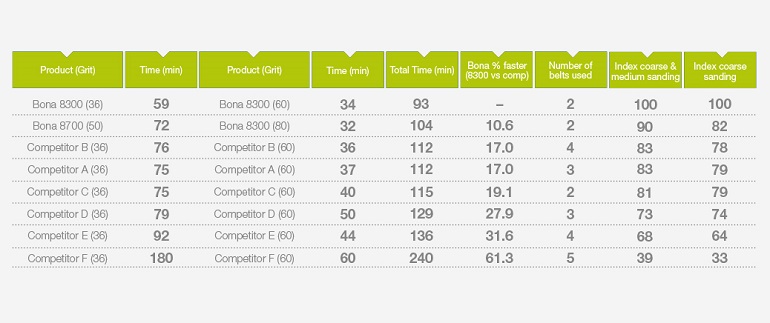
Bona 8300 (grit 36) exhibited ultimate speed and toughness. Its unique zirconium mix completed the coarse sanding in only 59 minutes. Bona 8700 (grit 50) came in on second with a total sanding time of 72 minutes, still faster than all competitors despite its finer grit.
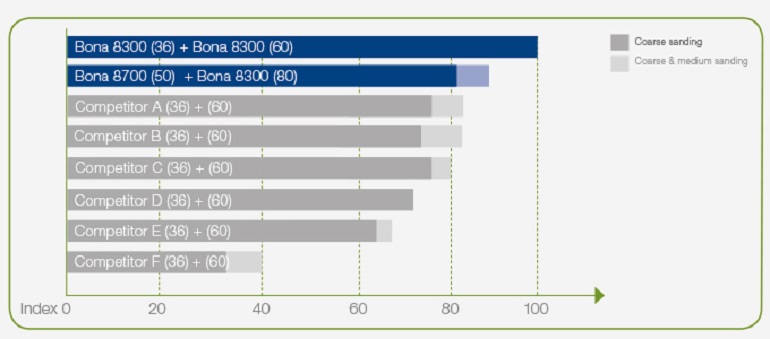
When sanding sequence Bona 8300 (grit 36) + Bona 8300 (grit 60) had sanded the entire test area, the closest competitor had only mangaged around 80 % of a corresponding area - see chart below:
Durability
"Up to three times as durable"
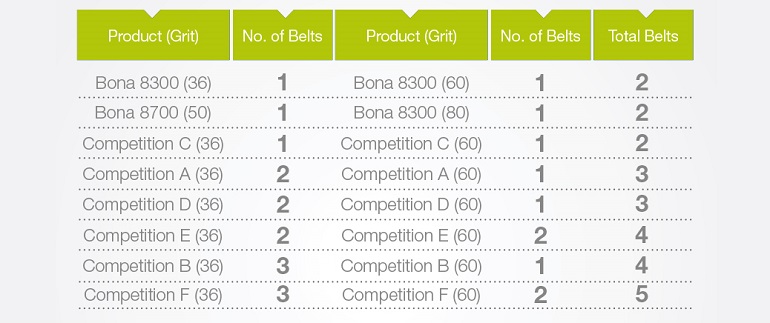
Durability was tested in terms of number of belts used to complete the sanding process. A minimum of 2 belts were used, 1 for coarse sanding and 1 for fine sanding.
In the test, Bona Abrasives proved a superior durability, lasting up to 3 times longer as the competitor abrasives. It's thanks to to the unique mix of abrasive particles and due to the fact that the grit structure self-sharpens and maintains its aggressiveness over time. Below shows how many belts were needed to sand the 75 m2 test area:
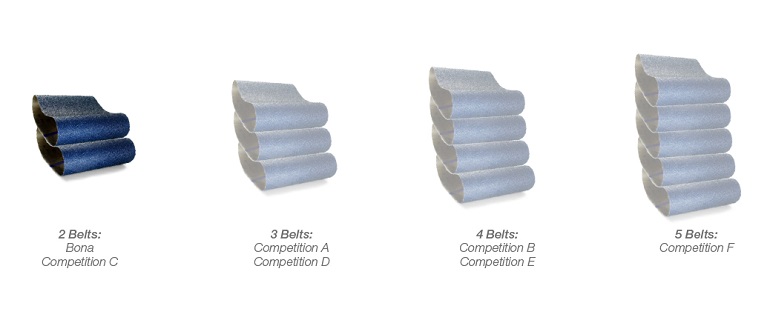
Bona 8300 (grit 36) and the Bona 8700 (grit 50) required only 1 belt each to complete the process. All competitor abrasives except one needed at least 2. The competitor abrasive only needing 1 did significantly more damage to the surface, causing deep scratches and substantial fibre ripping. Chart below shows abrasive perfomance in terms of number of belts used:
Surface quality
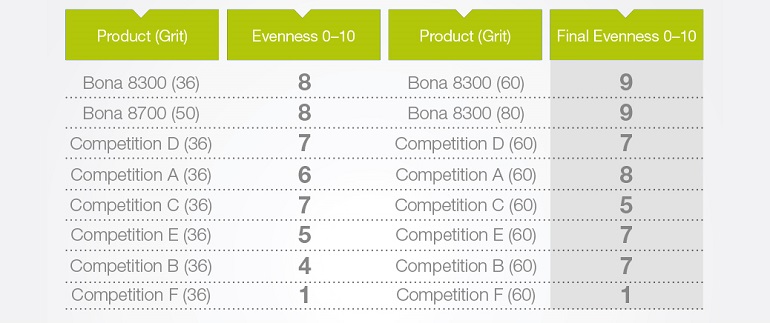
"32% more even surface"
Most abrasives on the market originate from the metal sanding industry. These can be effective for removal but are often too damaging to wood surfaces. Fibres are ripped from the surface during sanding, creating deep scratches which are difficult to remove with medium grit papers. The consequence is significantly longer sanding processes.
Using the Bona 8300 (grit 36) and Bona 8700 (grit 50) for coarse sanding resulted in less scratches and less fibre ripping on the surface, saving precious time during medium and fine sanding.
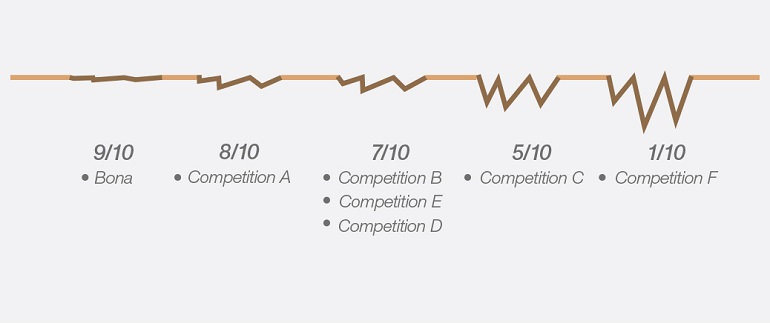
The surfaces sanded with Bona were smoother, more even, with visibly less fibre ripping. Efficient abrading is accomplished without compromising on gentleness to the floor, focusing on minimal damage to the surface. This is how all abrasives performed in regard of surface quality:
Fibre ripping
"Less ripping & scratching"
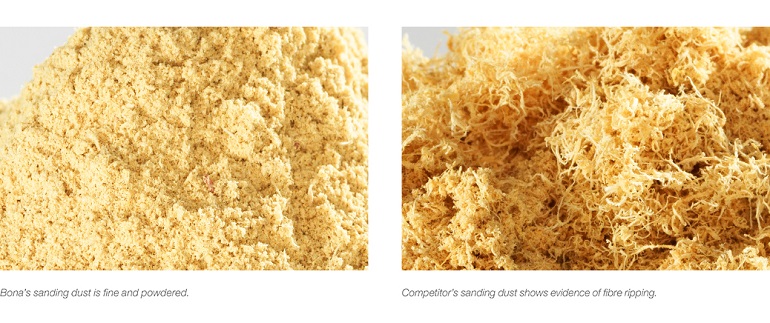
The residue from using Bona Abrasives is fine and powdery unlike fibres from competitor abrasives. The test shows that coarse & medium sanding with Bona Abrasives grind the surface gently without damaging the wood, despite their effective finish removal.
The more even an abrasive's grit surface is, the easier it is to achieve a smoother surface. Bona Abrasive 8300 did display a significantly more even grit structure than its competitors'.
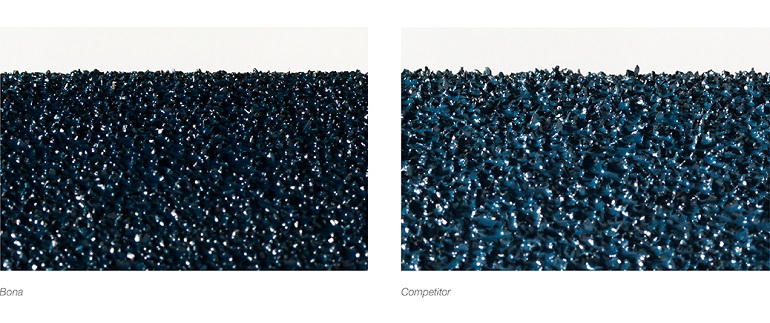
The sanding dust's fineness is evidence of whether the abrasive grinds the floor evenly, or removes fibres from the wood and damages it. The sanding dust from Bona Abrasives 8300 & 8700 shows no evidence of fibre ripping. Competitor results show that wood fibres have been ripped out from the surface, indicating that the abrasives aren't suitable for wood sanding.