
The Evolution of Sanding: Wood Floors, Sanding Tools and How They Evolved
Products for sanding wood floors have come a long way since the beginning of wood flooring. Discover which ones work best for today’s contractors.

The Evolution of Sanding: Wood Floors, Sanding Tools and How They Evolved
Products for sanding wood floors have come a long way since the beginning of wood flooring. Discover which ones work best for today’s contractors.
History of Hardwood Flooring and Sanding
There are differing ideas about when and where hardwood floors first came into existence. Some historians speculate that the Hittites may have installed some of the first hardwood floors in caves near the Black Sea.
Louis the 14th and the Palace of Versailles Parquet Flooring
It’s safe to say that wood flooring really began to come into fashion among the royal classes in the 1600s –– one of the most famous and brilliant examples of which were the parquet floors of Louis IVX in the Palais de Versailles. Solid plain oak flooring features a stunning pattern that is known to this day as Versailles Parquet.
In those days, the installation and finishing processes were arduous, to say the least. Imagine having to do everything by hand from the cutting of the planks to the sanding. Floor sanding was done with actual sand that was carried in and then rubbed into the flooring until smooth. Somewhere along the line, someone must have said, “There has got to be a better way.” Indeed, there was.
Colonial America and 18th Century Hardwood Floors
Moving on to the New World and the colonial days of America, the abundance of timber made the luxury of wood flooring available to the more common home. Folks could say farewell to earthen floors and hello to the warmth of hardwood floors. Still, the advent of the circular saw and sophisticated wood sanding tools were many years away. Logs were pit-sawed into planks; a process that took two men, careful planning, and hard, physical labor. In many cases and apart from the wealthiest home and business interiors, the sanding of floorboards was not even something that was done. The lumber was left unfinished and simply burnished over time as a result of daily traffic. Suffice to say, the wood floors of the Colonial Era were quite rustic and far from “luxurious,” by today’s standards.
Wood Floor Developments of the 19th Century
Fast forward to the 19th Century and the Industrial Revolution. Along comes steam-driven woodworking machinery that allows for the production of finished boards and planks on a mass scale, hence making wood flooring more accessible. In the Victorian Era especially amongst the upper classes, wood floors became fairly ubiquitous and were typically made from pine, and occasionally oak and mahogany. Although builders were learning better methods of how to sand wood floors, the overall process was still quite difficult. Floors were hand-scraped and sanded, using 25-pound blocks that featured a natural bristle-brush base attached to what was essentially a broom handle.
20th Century Hardwood Flooring Innovations
Wood flooring remained popular until the Great Depression, at which point everything changed. Average consumers were looking for much more affordable options (such as linoleum), and as a result, custom hardwood floors decreased in popularity. It wasn’t until the 1980s that they really made a distinct comeback.
Before the 80s resurgence of wood floors, a special invention that made a huge difference to contractors was the belt sander, developed in 1969 by the brilliant Eugen Laegler of Gügligen, Germany. With belt and drum sanders, 90% of the wood floor area or sq’ could be sanded smooth. Remaining edges and corners could be tackled with an edge sanding machine.
Bona® Makes Life Easier for Wood Floor Contractors
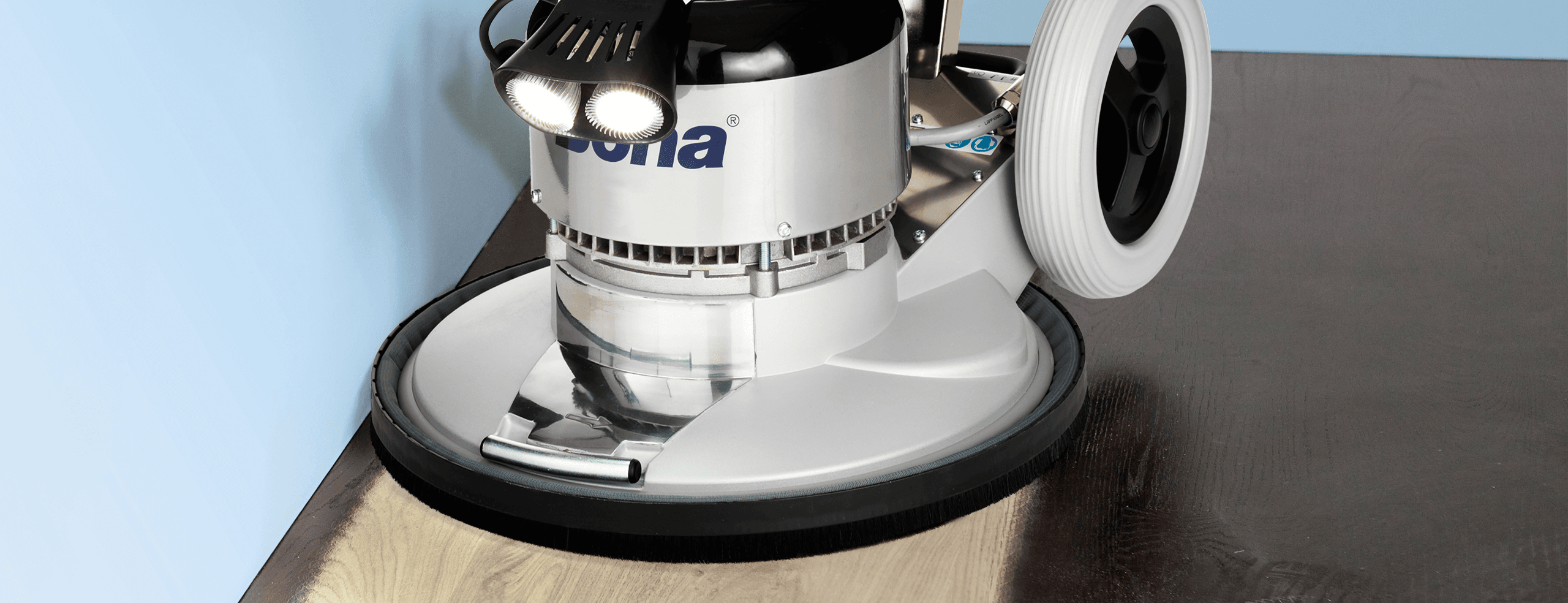
Now, here we are in 2022, and of course, wood floors are once again very popular –– and wood floor finishing has come a long way. Buffing machines such as the Bona FlexiSand DCS® Buffer and Bona Power Drive® make sanding jobs easier and smoother by virtue of increased efficiency. The Bona® Multidisc 16” with Diamond Abrasives eliminates swirls and scratch marks, creating a smooth, flat surface as the discs spin independently of one another; providing the best of professional quality workmanship.
Why Not to Use Steel Wool, Screens and Double-sided Hard Plates On Wood Floor Projects
Some floor contractors may still use materials such as screens and steel wool on wood floor sanding jobs. There are a number of reasons why the use of screens and sanding with steel wool are not recommended.
- Screens contribute to problems such as dish-out of the soft grain, and can cause deep scratches and swirls; i.e., damage (same as with double-sided hard plates).
- Screens wear out faster and therefore, are less efficient.
- Steel wool can actually leave rust stains as microfibers find their way in between layers of waterborne finishes.
“Let the machine do the work.”
In general, and throughout history, flooring contractors have found that if there are better sanding tools and machines that can save time and money as well as improve their level of craftsmanship, the choice becomes clear. At Bona, we strive to make the best possible tools and products for your flooring needs, to help make your choices simpler and your workdays easier.
For more information about how to create perfect hardwood flooring surfaces, please visit the following:
Want to become a better craftsman? Attend the Bona® Sand and Finish School – for professional wood flooring contractors (not for DIY/homeowners).