
Bona Floor Adhesives: Frequently Asked Questions and What to Consider
Choosing more sustainable wood floor adhesives makes a difference in the overall health of hardwood floors and the homes in which they exist.

Bona Floor Adhesives: Frequently Asked Questions and What to Consider
Choosing more sustainable wood floor adhesives makes a difference in the overall health of hardwood floors and the homes in which they exist.
Making smart wood floor adhesive choices
Professional flooring contractors know that good floor adhesives can make or break a wood flooring project, and superb wood floor adhesives can lead to the long term success of a hardwood floor
Bona’s silane-based floor adhesives offer superior shear strength and excellent spread rates. They won’t etch, damage or stain the finish of any pre-finished and site finished wood. No pails will be wasted and the risk of “skin over” is almost non-existent.
In this article, we’ll cover the important details about Bona’s wood floor adhesives that flooring contractors need to know.
Bona® Silane-Based Floor Adhesives

Bona QUANTUM™ R851
Bona QUANTUM™ R851 is a silane-based, adaptable floor adhesive. Its outstanding green-grab and easy application does not cause fatigue.

Bona QUANTUM™ T
Bona QUANTUM™ T silane-based floor adhesive makes uneven substrates an issue of the past, as it helps to minimize the gaps.

Bona VERTICAL™
Bona VERTICAL™ is a silane-based construction adhesive with soft elasticity but high bonding strength for rapid setting.
A solid foundation starts with Bona wood floor adhesives
Bona silane-based floor adhesives are part of the Bona System®, an elite family of professional products that are made to work perfectly together. We make our own formulations, so our products are one of a kind. Here are the qualities you can expect from our wood floor adhesives:
- Easy to apply with no arm fatigue
- Easy to clean and won’t harm finish
- Excellent “green grab” keeps flooring in place
- “Memory free” prevents drift between board seams
- Rapid shear strength allows foot traffic in one day
- Exceptional ridge stability for maximum adhesion
- Compatible with radiant heat systems
- Protects up to 18 lbs and 95% RH
- Includes tow clip-on trowels in every pail
- Water and solvent free
- Prop 65 compliant
- Zero VOCs
… And last but definitely not least, Bona wood floor adhesives are first in the industry to receive the GREENGUARD GOLD certification!
By choosing Bona adhesives, you’re reducing environmental impacts and helping to create healthier, safer interiors for your customers. Here are the eco-friendly facts about Bona Silane wood flooring adhesives:
- Bona Silane-based adhesives are GREENGUARD GOLD certified for indoor air quality, whereas urethane wood floor adhesives release airborne chemicals in vapor form.
- Our adhesives emit zero (0) volatile organic compounds (VOCs). Compare that to the high VOC emissions (until cured) of urethane wood floor adhesives.
- Bona adhesives deliver advanced technology to protect your investment and health.

The GREENGUARD Gold Certification Standard includes health-based criteria for additional chemicals and also requires lower total VOC emissions levels to ensure that products are acceptable for use in environments such as schools and healthcare facilities. … All certified products are subject to a review of the manufacturing process and routine testing to minimal impact on the indoor environment.
Do Bona wood floor adhesives offer moisture protection?
Yes. 18 pounds and 95% RH with standard MPB clip-on trowel.
What is the sound rating for Bona hardwood floor adhesives?
Bona adhesives meet ASTM E92-09 and ASTM E90-04 and IIC with ceiling.
Do Bona adhesives provide freeze-thaw stability?
Yes – down to zero degrees.
Hardwood floor suitable substrates and Bona Floor Adhesive application
Suitable substrates include concrete, plywood, cork, particle or chipboard, stone, ceramic, terrazzo, Warmboard®, radiant heat flooring, dry above-grade gypsum underlayment and recycled rubber underlayment.
Can Bona® floor adhesives be used to glue to rubber and acoustical rubber mats?
Yes. Use the Bona 1000F trowel or Bona Engineered Flooring (EF) trowel.
Floor adhesive application
Does the wood floor adhesive need to be back-troweled or ‘keyed in’?
No, but by back-troweling or keying in the adhesive, the moisture protection will increase to 15 lbs – one of the best ratings on the market.
Bona R540 Moisture Barrier & Primer
Bona R540 is a recommended treatment as optimal conditions are rarely experienced when laying a floor. Non-ideal conditions leave the contractor with three options: proceed with the installation and risk that the floor will cup, delay the job, or mitigate the risk and delays by using Bona R540.

Bona R540
Bona R540 is a single component, roll-on moisture barrier and primer, used to mitigate floor moisture issues such as cupping.
Does building paper have to be used with Bona R540?
No, it isn’t required.
If you're only nailing and not using the floor adhesive, what is the wait time?
It dries fast and you can start within 1-2 hours.
Are chalk lines still visible?
Yes. Unlike building paper that can move around, Bona R540 locks chalk lines in.
Does the wood still need to be acclimated?
Yes. Best practices should always be followed.
What is the pot life?
Bona R540 is a one-component product with no pot-life issues.
What if the subfloor is a resinous wood subfloor system?
Bona R540 is particularly useful on resinous wood subfloor systems. It acts as a primer for increased adhesion.
When using Bona R540, is it necessary to use building paper (or felt paper) under the flooring?
No. Unlike building/felt paper that can be torn during installation, Bona R540 provides a continuous layer of film protection. The liquid moisture barrier/primer protects up to 20% moisture with one coat on any wood subfloor and can be applied with a ¼” nap roller. The NWFA states that for strip flooring, there should be no more than 4% difference between subfloor moisture and wood flooring moisture. With plank flooring (which is 3” and wider), there should be no more than 2% difference. On concrete, two coats of Bona R540 will protect up to 95% RH and 18 lbs.
Bona QUANTUM™ FAQ
Why use Bona QUANTUM™ Floor Adhesive?
Since its development, silane technology has increasingly been specified by the A&D community.
- Bona QUANTUM™ adhesive has exceptional shear strength for today’s wide plank flooring.
- Despite this improved shear strength, silane adhesives do not stick to or harm the surface of a prefinished wood floor. Urethane-based adhesives are known to be extremely difficult to remove from the surface. This etching of the finish can result in sheen differences. Bona QUANTUM can be easily removed without etching the finish, even three days later.
Why not use an off-the-shelf, all-purpose type of floor adhesive?
General construction and all-purpose adhesives are not specifically designed for hardwood floors. These adhesives do not have the necessary elongation built into them for the expansion/contraction necessary for wood floor installations. An adhesive must allow for this natural movement and not be too rigid, otherwise any expansion spacing will not have the flexibility needed to accommodate seasonal changes in relative humidity or moisture content. Multi-purpose adhesives may also crystallize over time, becoming susceptible to forces of shear, resulting in the bond being compromised.
Engineered floors are stable, so why is a nail and glue assist recommended?
Over the years the NWFA has seen a huge increase in “noisy, squeaky, loud floors”, and now include Glue-Assisted Nail-Down instructions in the Wood Flooring Installation Guidelines.
- Installers using lighter gauge staples on some thin engineered flooring products could be inadvertently diminishing the holding power.
- Today’s subfloors are subjected to weather and heavy trade activity before the flooring installer even arrives – posing a challenge to traditional fastening methods.
- The tongue on thin engineered flooring may not be strong enough to hold the flooring in place, especially in high traffic areas. Bona QUANTUM has the necessary shear and tensile strength for these demanding situations.
Why is it important to glue assist with wide plank flooring?
The wider the plank, the less fasteners per square foot to secure the floor. The NWFA recommends using adhesive for flooring greater than 5 inches. Some installers are using adhesives on planks that are 4” or wider, with more flooring manufacturers recommending this as well. A glue assist will keep floors in place and greatly reduce the risk of call backs.
What is the benefit of a nail and glue assist when the subfloor is in good shape and the moisture readings are in an acceptable range?
The trend in the industry is continuing to move toward wider width planks. This dimensional increase in material warrants not only relying on fasteners along with the engagement of the tongue and groove. Even the slightest lateral movement can cause squeaking and popping. No homeowner will be satisfied with creaking floors and the remedy is often top nailing and/or drilling holes in their new floor to shoot epoxy in the face of the boards.
Isn’t it expensive to nail AND glue?
Compared to full troweling, it is very economical. Installers will use almost 100% of every tube. Unlike other adhesive in caulking tubes, it does not harden. Even weeks later, simply pull out the plug of adhesive in the nozzle and go to work. When you consider the benefits and few call backs, it is a great investment.
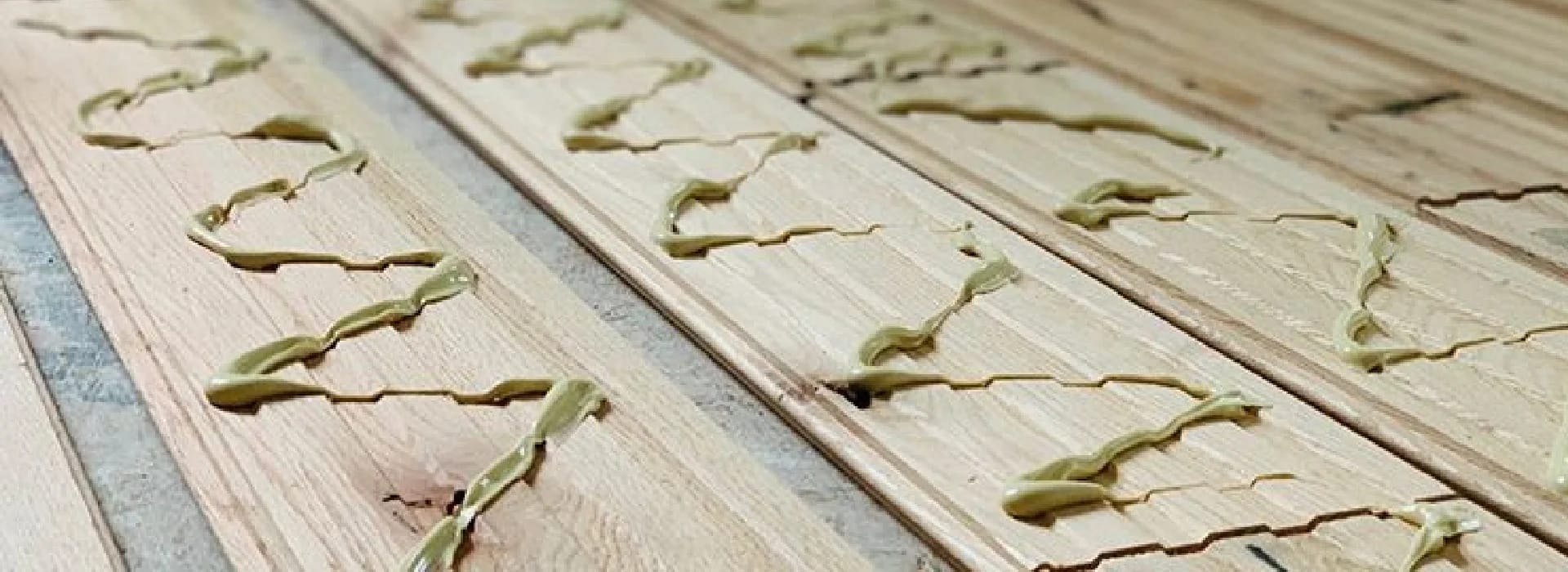
How should Bona QUANTUM be applied? Serpentine (sinewave) pattern? Parallel stripes pattern? Ends and grooves pattern? Lengthwise parallel stripes?
Bona finds that installer preferences include all of the above techniques. The serpentine pattern is performed approximately twice the width of the board. The parallel stripes pattern may run perpendicular to or diagonally every 6”-8”. The ends and grooves pattern is placed within 1” from both ends of the board and along the full length of the groove side of the board. The lengthwise parallel stripes pattern is placed within 1” of each long side edge and down the middle of the board.
What is the best way to remove and clean adhesive from the board face?
Many installers simply wait until Bona QUANTUM dries and then the spot with a Bona Microfiber Pad or putty knife. Odorless mineral spirits can also be used when the adhesive is wet.
Is Bona QUANTUM™ recommended for stairs and risers?
Yes. It is an excellent choice. Stairs are high traffic areas that can benefit from the exceptional shear strength of Bona QUANTUM™.
Will Bona QUANTUM™ bond to metal?
Yes. It has an excellent bond to metal which allows for greater diversity in staircase installations. Just remove any contaminants including grease or lubricants.
Will Bona QUANTUM™ bond to a radiant heat floor or gypsum-based concrete?
Yes. Lightly abrade the gypsum-based concrete first for a good bond.
Where are Bona floor adhesives made?
Bona proudly makes Bona QUANTUM R851, Bona QUANTUM T and Bona QUANTUM at our manufacturing facility in Monroe, N.C. Bona VERTICAL and Bona R540 are made at our manufacturing site in Limburg, Germany.
We hope you found the information about Bona adhesives helpful! For more great tips and guides for professional flooring contractors, check out these articles.

Moisture Mitigation with Bona R540
Flooring contractors who understand moisture mitigation as it relates to hardwood floors know that moisture testing and proper preparation are crucial. Learn the steps to success.

How to Be a Sustainable Floor Contractor
Using products and systems that are better for the environment and health is expected by consumers. Learn how to show your commitment to the cause with these tips.

How to Reduce Airborne and Floor Impact Noise
The types of noise that travel throughout spaces with hardwood floors are airborne and impact noise. Help reduce airborne and floor impact noise with Bona silane adhesives.